
You've Been Successful. But Something Still Feels Off.
There is a version of you that runs the meeting, delivers the quarterly results, manages the team of forty, and holds the room together when no one else will.
You have built a career on that ability. And probably a life.
And there is a version of you that drives home afterward in silence, knowing that the person who just performed so well is not the person who you feel like you actually are. Knowing that what is waiting at home may not be much different.
The same distance,
the same control, and
the same inability to let people in.
You may not have language for it yet. But you feel it.
You have been living in the gap between who you perform as and who you actually are
for a long time.
The Exhaustion You're Feeling Isn't About Sleep
The exhaustion underneath all that performance has nothing to do with how much sleep you got.
It is your survival strategy.
And it has been running for a long time.
Survival patterns are not character flaws.
They are strategies that worked once and never got updated.
Trauma exists on a spectrum. From the significant events most people associate with the word to the daily, accumulating wounds from our relationships that rarely get named.
Both create survival mechanisms that keep us trapped in fear-based living: reacting from old pain instead of responding from who we actually are.
These are not personality traits.
They are adaptations.
And they can change.
The HEAL Framework™
The HEAL Framework™ is my proprietary pathway from surviving to thriving. It grew from thirty years of observing human behavior under pressure as a forensic accountant investigating fraud and white-collar crime, from my own lived experience of recognizing and healing the survival patterns that shaped my life and leadership, and from the work I now do helping others do the same. Today, I bring that framework to both leaders whose survival patterns are shaping how they lead and individuals ready to heal the patterns shaping how they live.
HEAL stands for Hope, Evolve, And Love.
Each one is an action word, not a concept. Together, they are the healing journey.
HOPE
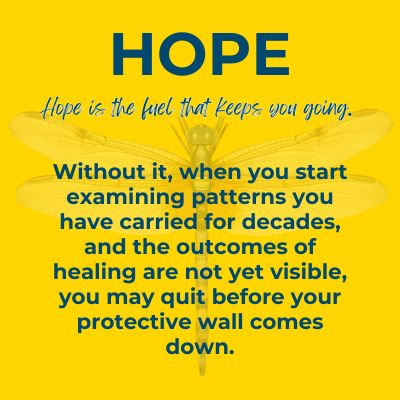
To hope is to build the fuel that keeps us going when the journey gets hard, and the results are not yet visible.
That is not a metaphor. Without hope, we quit. When someone begins to examine the survival patterns that have been running their behavior for decades (control, perfectionism, emotional distance, over-responsibility, busyness), the process can surface pain that makes it tempting to stop. Hope is what sustains us through those moments.
But hope is not optimism. Optimism is the general belief that things will work out. Hope is something more specific and more durable. It combines two forces: agency (the goal-directed energy that says “I can do this”) and pathways (the ability to plan and find a way forward, even when the first path is blocked). Optimism can be lost. Hope, built this way, can be rebuilt and strengthened because it is rooted in action, not in circumstance.
Hope is not the belief that things will be fine. Hope is the decision to keep walking when you cannot see what’s ahead.
Hope can be systematically built. Through daily practices like gratitude, collecting evidence of your own and other people’s healing, and reflecting on your own resilience (the proof that you have already survived hard things and are still here), hope becomes fuel rather than a feeling you wait for.
FROM BETH'S JOURNEY:
I lost my optimism during my own healing journey. What replaced it was something deeper: resolve. That resolve is what I call hope. It kept me moving forward through the hardest discoveries about myself, through the grief for what I had lost as a result of my trauma, through the moments when my inner critic was louder than anything else in the room. Hope is the reason I’m still here, doing this work. And it is the first thing I help others find.

EVOLVE
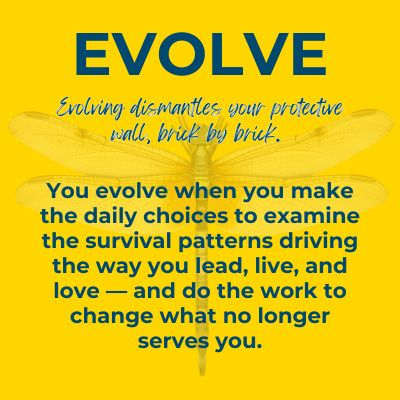
To evolve is to be active in the healing journey. It is the work itself to let go of what no longer serves.
Evolving in this framework has two dimensions. The first is the healing tools: using real resources and modalities that help you to release what you’re carrying, restore your nervous system, rewrite your narratives, and protect and nourish yourself. The second is self-discovery: learning who you were always meant to be underneath the survival patterns, the wall, the performance, the people-pleasing, the control. Most of us have spent so long operating from a place of survival that we have no idea who we are without it.
The healing toolkit.
The survival patterns most people carry are not intellectual problems. They live in the body. They automatically fire in the nervous system when we're triggered. They show up as reactions that are slightly too large (or too small) for the moment. Healing them requires tools designed for more than understanding. It requires practical tools that work in real life, not just in a therapy session.
A comprehensive healing toolkit, built just for you, will help you to heal in the following ways:
Release
Letting go of traumatic events, distorted stories, stuck emotions, and wounds stored in the body (the grief you never processed, the anger you swallowed, the tension you carry without knowing why)
Restore
Returning the body's nervous system to a regulated state so you can respond rather than react (the emotional outburst, the racing heart in a meeting that doesn't warrant it, the shutdown when someone gets too close) to life's events
Rewrite
Replacing the narratives that survival built (the inner critic's scripts, the impostor syndrome loops, the stories about who you are and what you deserve) with narratives grounded in truth
Protect
Establishing boundaries and practices that prevent old patterns from re-entrenching (the relationships that pull you backward, the environments that trigger old responses, the coping habits that keep you stuck)
Nourish
Feeding yourself emotionally, physically, and spiritually so healing is sustainable over time (the rest you deny yourself, the joy you have forgotten to pursue, the connections that actually fill you instead of draining you)
Self-discovery.
The other dimension of evolving is learning who you actually are. When survival patterns have been running for decades, most people have never met the version of themselves that exists on the other side of the wall. They know the performer. They know the fixer. They know the person who holds everything together. They do not know the person underneath.
Self-discovery in this framework is a specific kind of work. It means examining the patterns that keep you small: impostor syndrome, the inner critic’s messages, emotional triggers, and what I call your Achilles’ heels (the places where your greatest strengths become your greatest vulnerabilities). It means identifying your core emotional needs and honestly assessing whether they are being met. It means learning to recognize your inherent gifts and strengths, often by seeing yourself through the eyes of people who know you well, because survival taught most of us to dismiss our own worth.
Most of us have spent so long operating from survival that we have no idea who we are without it. We’re evolving as we do the work to find out.
FROM BETH'S JOURNEY:
Through my own healing journey, I explore and continue to use multiple modalities: trauma therapy, EMDR, hypnotherapy, inner child work, somatic practices, Reiki, writing as a healing tool, and spending time in nature, among others. I’ve used my tools consistently enough that I know which one will work best for me in the moment, depending on whether I am releasing, restoring, rewriting, protecting, or nourishing myself.
What I teach in The HEAL Framework™ is not a single technique.
It is a structured approach to identifying which combination of tools works for you to understand what's happened to you and to manage and heal the ways that you cope and survive. Using them consistently enough is what creates lasting change. Healing is a lifelong journey. The wounds that surface at year one are not the same ones that surface at year five, and the triggers you thought you had handled will find new ways to show up. That is why mastery of your personal toolkit is not a nice-to-have. It is what allows you to respond with speed and resilience when life inevitably brings new wounds that need tending. Every survivor's toolkit looks different because every survivor's story is different.
FROM BETH'S JOURNEY:
When I finally turned my forensic lens inward, I found a woman who had no idea who she was behind the wall she had built. I knew the performer. I knew the fixer. I did not know what my emotional needs were, let alone whether anyone was meeting them. I did not know my inner critic had been running the show since childhood, and I had mistaken her voice for discipline. Self-discovery, for me, was the first time I met myself.
Evolution is where your protective wall comes down. Not all at once. Brick by brick, day by day, choice by choice. The work is hard and sometimes painful. But the outcome (love) is worth it.
AND
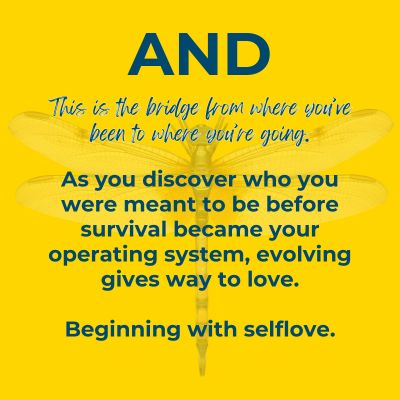
And is the bridge.
There is a reason the word “And” sits between Evolve and Love in this framework. "And" marks the crossing point: the moment when evolving as a human being gives way to something you did not expect to find.
As you discover who you were always meant to be (who you are underneath the survival strategies, the performance, the protective fortress), evolving gives way to love. Not because you earned it. Not because you completed a program. Because the wall that was blocking it is coming down.
“And” is the bridge between the hard work and the reward. Between fear-based living and love-based living. Between the person you built to survive and the person you actually are.
LOVE
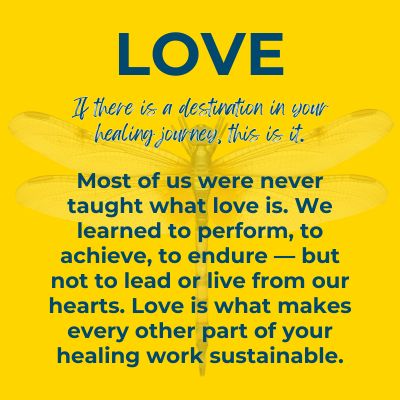
Love begins with self-love and learning to love from the heart. Love is what makes every other part of healing sustainable.
If there is a destination on this journey, it is love. Not romantic love (though that may come) and not the love you perform for others. This is the kind of love that starts with accepting yourself as you actually are: your vulnerabilities, your limitations, your gifts, your emotional needs, your history, all of it.
Self-love is not a soft concept. It is the foundation of mental health. It enables authentic relationships. It drives better decision-making. It acts like an emotional immune system, reducing the need for external validation and breaking the cycles of self-sabotage that keep so many of us stuck. When I say “self-love first,” I mean it as a daily practice, not as a slogan.
The mirroring process.
One of the most significant parts of the Love phase is learning to mirror: a three-step process that begins with understanding yourself as a survivor, then recognizing that the people who hurt you are often survivors shaped by their own experiences, and finally extending the same grace to them that you have learned to give yourself. This is not about excusing harm. It is about releasing the fear-based emotions (the anger, the resentment, the need for control over the outcome) that keep you tethered to the wound instead of free from it.
True love is self-love. No one can love me or you better than we can love ourselves.
Today, I know I’m enough. I also know that you’re enough.
Relationships after healing.
Love is where healing stops being a solo project and starts shaping how you relate to everyone around you. Survivors often carry relationship patterns they have never examined: choosing partners who replicate old dynamics, tolerating behavior that violates their boundaries, giving without reciprocity because that is the role survival assigned them. Through The HEAL Framework™, you learn to assess the health of your relationships honestly, set boundaries that protect your healing, and build connections rooted in mutual respect, emotional safety, and authenticity.
FROM BETH'S JOURNEY:
I arrived at self-love after realizing that the three people I most expected to love me had never loved me the way I needed. The scariest question was not whether I was lovable. It was the possibility that I had never experienced real love and therefore had no idea what I was looking for. The first time I recognized something resembling unconditional love was with two friends who held space for the hardest conversation of my life, accepted everything I said, and told me the truth. From that night forward, I began learning what love actually looks and feels like.
This applies to every type of relationship, personal and professional. When leaders do this work, their teams notice. Trust rebuilds. Communication changes. The people around a healed leader experience a completely different kind of authority: one rooted in clarity and emotional steadiness instead of control and distance.
Love is the reason to heal. Not because someone told us to. Not because of some popular new healing modality we’ve heard about. Not because we read an article that made us feel guilty about our leadership style. We do it because somewhere inside, we know that the life we’re living is not the one we were meant for. And we want the real one.
How the framework applies to leadership performance.

Many high-performing leaders built their success on survival strategies developed long before they ever held a title. Control. Perfectionism. Emotional distance. Over-responsibility. Hyper-vigilance. These patterns create results. They also create strain: on teams, on relationships, on the leader’s own capacity to sustain the work over time.
Traditional leadership development programs focus on skills such as communication, delegation, strategic thinking, and emotional intelligence. Those programs are not wrong. But if the root cause of a leader’s behavior is a survival pattern that formed years or decades before the leadership role (whether rooted in childhood, compounded by later experiences, or both), skill-based interventions alone will not produce lasting change. Improvements in leadership behavior may last for a few weeks, but then the old pattern resurfaces because its source was not addressed.
The HEAL Framework™ addresses that root cause. Through the framework, leaders learn to:
Recognize
the survival behaviors influencing how they lead, communicate, and relate to others
Name the impact
of those behaviors on trust, clarity, authority, and team performance
Heal the emotional drivers
beneath those behaviors through structured, sustained work
Lead with alignment
developing a leadership presence marked by emotional steadiness, relational intelligence, and sustainable influence
The leader who operated from a place of control learns to delegate, and the bottleneck that slowed every decision opens up. The leader who kept people at arm's length builds trust, and the top performers who were quietly interviewing elsewhere because they felt undervalued decide to stay. The leader who reacted from a decades-old threat response starts responding from clarity, and the team stops spending its energy managing around the leader's survival patterns and starts spending it on producing real results.
Communication stabilizes. Turnover drops. Results are delivered. And the leadership pipeline strengthens because people actually want to move toward that leader, not away. These are not abstract improvements. They show up in individual and team performance, engagement scores, retention rates, decision-making speed, and 360-degree feedback. The return on healing is measurable.
Where this framework came from.

I spent more than thirty years as a CPA and forensic accountant, working on high-stakes fraud and white-collar crime investigations worldwide. In that work, I learned to read behavioral patterns under pressure: the tells, the inconsistencies, the reactions that reveal more than surface performance. I could see what others often missed.
What I did not see for most of those years was that many of the same patterns were running my own life.
At fifty, that became impossible to ignore. After a hypnotherapy session brought forward buried memories of childhood sexual abuse, I began to understand that the control, perfectionism, emotional distance, and over-responsibility I relied on were not simply strengths. They were survival strategies I began to develop as a child and carried into every relationship, every boardroom, every decision I made for decades.
That realization changed how I understood behavior. It also led me to build The HEAL Framework™: a structured approach born from lived experience, forensic-level observation, and the focused, intentional work of healing myself. I did not study this from the outside. I lived it. And now I help others do the same.
I wrote about this journey in Becoming an Empowered Survivor, which follows the full arc of my healing through hope, evolution, and love. The book is where the framework lives in its most personal and complete form, at least as far as my healing journey had progressed as of its publication date.
You, too, can heal.

If something in your life or your leadership has not fully made sense, there is a reason. That reason can be understood. And the survival strategies creating your uncertainty can change.
Those strategies that got you through the hardest parts of your life served a purpose. They kept you alive, kept you moving, kept you performing. They also built a wall between you and the life you were actually meant for.
The HEAL Framework™ is the pathway through that wall. Hope sustains you. Evolution does the work. And love is what you find on the other side.
You, too, can heal.
Ready to begin?
If you are a survivor and you know it is time to do the work, start with the Healing Quick Start Guide. It will walk you through the first steps on the pathway from surviving to thriving.
If you are a leader, whether you recognize these patterns in yourself and want to understand what is driving them, or you don't identify with the word "survivor," but something on this page describes your life, take the self-assessment. It will give you specific language for the patterns running your leadership and a concrete starting point for changing them.
If you are responsible for leadership development in your organization and you see these patterns showing up in your leaders, I would welcome a conversation about how I can serve you, your leaders and your organization.