
When Your Leadership Runs on External Validation: What Survival Mode Looks Like From the Inside
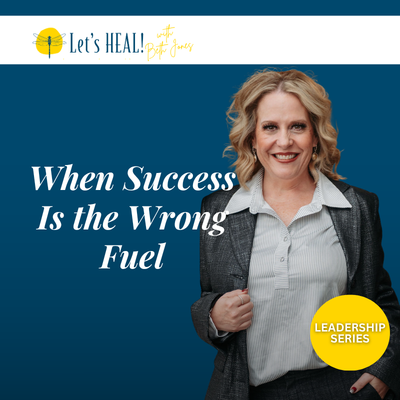
Most leaders who operate from survival patterns in leadership do not know they are doing it. They know something feels off. They may have been told they are too intense, too controlling, or too hard on themselves. But they attribute it to the pressure of the role, not to a wound that predates the job by decades.
Molly Moore Smith knows this pattern from the inside. She spent over 25 years in the tech industry, rising from entry-level to Vice President, managing $80 million in recurring revenue and leading customer-facing teams at a global enterprise software company. By every external measure, she was performing at the highest level. But the entire engine was running on the wrong fuel: external validation that had been her only source of self-worth since her very first job.
What this episode covers.
In this episode of Let’s HEAL! — The Leadership Series, Beth Jones sits down with Molly Moore Smith to explore what happens when external validation leadership drives your entire career, and then the validation stops. Molly names the survival patterns that ran her leadership for two decades (perfectionism, people pleasing, control, and numbing through alcohol), the identity crisis that hit when she changed companies and nobody knew her name, and the single scariest sentence she ever uttered to her boss. Now a Certified Emotion Code Practitioner and breakthrough coach, Molly helps high-achieving women release the trapped emotions driving their behavior. This conversation goes where her other interviews have not: into the patterns that drove her own leadership before she had the tools to see them.
This is where external validation leadership comes from.
Molly’s parents divorced when she was a young teenager. Both did the best they could, but there was scarcity and a void of emotional validation: being seen, being encouraged to feel feelings and process them in the moment. Her first job at a grocery store became the first place where her effort was rewarded in an overt, measurable way. That felt good. And it set the pattern for everything that followed.
From college through a two-decade corporate career, external validation was the fuel. Promotions, recognition from bosses, making leadership look good, and contributing to the bottom line. All of those are good things on their own. But when they become the only source of self-worth and identity, they create a dependency that looks like ambition from the outside and feels like survival from the inside.
“It was the only fuel, the only fuel for my self-worth and my identity.” — Molly Moore Smith
The survival patterns underneath.
When Molly looks back through the lens of her training as a Certified Emotion Code Practitioner, she can name the survival patterns that were running her leadership:
- Perfectionism — driving flawless execution as proof of worth
- People pleasing — making everyone else happy as a strategy for belonging
- Control — staying close to her vision of what success was supposed to look like
- Numbing — alcohol, scrolling, and binge watching to escape what she could not name
All four patterns served the same underlying wound: not feeling enough.
“All of those things, they’re all layers on top of the wound of not feeling enough.” — Molly Moore Smith
The pivot that changed everything.
In early 2023, Molly made two decisions. First, she stopped drinking for 100 days. She did not tell her husband, her closest friends, or anyone else. She was scared she would fail, and, as a health coach at the time, the vulnerability of admitting she could not stop pouring a glass of wine every night was more than she could bear to face publicly.
Six weeks into sobriety, she sat on a Zoom call with her boss and said the scariest thing she had ever uttered as an adult: “If success in this role means I have to spend 50% of my time doing things outside my skill set, then I am not the right person for the role.”
What followed was a title change, a salary reduction, and a change in influence. She stepped out of the C-suite and into a director role focused on the work she loved. And she says it was the most liberated she has ever felt.
“Had I been drinking during that season, there is absolutely no way I would have navigated it. No way.” — Molly Moore Smith
This is how trapped emotions drive leadership behavior.
Molly is now a Certified Emotion Code Practitioner, trained in Dr. Bradley Nelson’s energy-healing modality, which identifies and releases trapped emotions stored in the body. Trapped emotions are negative, low-level, or fear-based emotions that were not processed in a healthy way at the time the related traumatic or abusive event (s) occurred. The energy of that emotion gets lodged in the body and can drive subconscious patterns, including outsized reactions, difficulty trusting, people-pleasing, and survival behaviors that show up in leadership without the leader knowing why.
Through The HEAL Framework™ — to Hope, Evolve, And Love, each as an action — leaders can recognize the survival patterns driving their behavior, understand their origins, and begin choosing different ones. Molly’s story is a case study in what that process looks like: naming the patterns, addressing the root cause, and rebuilding leadership from alignment rather than from a wound.
You, too, can heal.
If something in Molly’s story sounds familiar, you are not alone. The survival patterns that got you through the hard parts of your life served a purpose. They can also change.
Email Beth directly: beth@empoweredsurvivors.com
Learn more about Beth as a speaker at your organization
Watch our last episode in the Leadership Series with Chason Forehand: When Survival Mode Becomes Your Leadership Style
Q&A: External Validation and Survival Patterns in Leadership
External validation leadership is when a leader’s self-worth and identity are tied primarily to recognition, approval, and measurable achievement from others. The leader performs at a high level but depends on external confirmation to feel competent, creating vulnerability when validation stops or the environment changes.
Common survival patterns include perfectionism, people pleasing, control, and numbing behaviors such as overwork, alcohol use, or emotional avoidance. These patterns often form in childhood in response to emotional scarcity and carry over into leadership roles, where they appear as strengths until they stop working.
Yes. Many leaders perform at the highest levels while running on survival patterns they cannot see. External success metrics like promotions, revenue targets, and team performance can mask internal misalignment, identity crises, and emotional exhaustion that erode both the leader and the people around them.
When leaders address the survival patterns driving their behavior, they gain access to the trust, empathy, and emotional clarity that effective leadership requires. Through The HEAL Framework™, leaders move from surviving to thriving, and their teams benefit directly from that shift. Healing is a career imperative for leaders who want sustained performance and genuine alignment.
Categories
OUR BLOGS
Recent Posts
What Imposter Syndrome Looks Like Inside a Leadership Meeting
Most of the imposter syndrome conversation stops at the feeling. Not good enough. Don’t belong….
Conflict Avoidance Is a Leadership Behavior With a Measurable Cost
Conflict avoidance goes by a lot of names: patience, diplomacy, being easy to work with….
Stop Performing for Approval and Start Leading
Some of the most capable leaders in an organization are also the most exhausted, and…