
Unconscious Bias, Race, and the Survival Patterns Leaders Cannot See
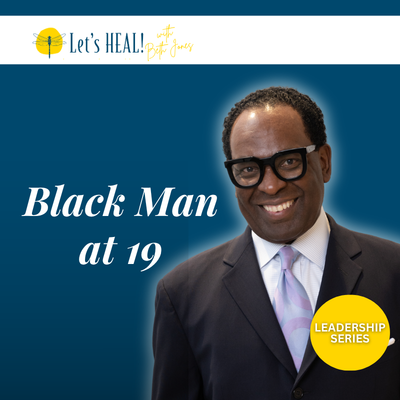
Most conversations about unconscious bias in the workplace stay at the surface: acknowledge it exists, commit to doing better, move on. What those conversations rarely reach is the survival conditioning underlying the bias, the patterns that formed before anyone entered the workforce, and the organizational cost of leaders who cannot see what drives their decisions.
Rick Hightower knows this territory from the inside. A CPA, Certified Internal Auditor, author, and DEI practitioner who spent more than 20 years building culture programs inside Fortune 100 companies, Rick grew up in an all-Black neighborhood in Atlanta. He arrived at TCU (a university in Fort Worth, Texas) at 19 and discovered for the first time what it meant to be a Black man in a predominantly white world. That discovery created survival patterns that shaped every professional decision he made for the next three decades.
What this episode covers.
In this episode of Let’s HEAL! with Beth Jones — the Leadership Series, I sit down with Rick Hightower to name the survival patterns that navigating race and leadership in America creates: working harder than everyone around you and watching people who didn’t work as hard receive more, the false arrest at TCU that taught Rick early that his skin color was criminalized, and the exhaustion of building a career inside systems that were not built for him. Rick introduces the concept of aversive racism, and I share my own unconscious bias story and ask whether it crossed into my leadership. If you lead people and you have never examined where your instincts about others actually come from, this conversation will challenge you.
I wrote about unconscious bias in leadership last week on Substack, informed in part by this conversation with Rick. The article and this episode of my podcast are among my best works to date, and I am very proud of them. I hope you’ll spend time with both.
When the world tells you what you are.
Rick describes growing up in an all-Black neighborhood where race was not something he thought about. It was his normal. Then he arrived at TCU and found himself one of maybe 30 students who looked like him on a campus of thousands. In his words, he was petrified.
That experience created a survival strategy that would run the rest of his career: prove you belong. Work harder. Make yourself impossible to ignore. And never let them see you afraid.
— Rick Hightower
“I discovered I was black when I was 19. Until that time, I didn’t know that.”
What makes Rick’s story instructive for leaders is his own initial framing. Before the conversation started, he told me he didn’t think he’d had any major trauma. By the end, he was naming survival patterns he’d been carrying for decades. That gap between what we think we’re carrying and what we actually are is exactly where unconscious bias lives.
The cost of navigating a world that was not built for you.
Rick spent decades inside Fortune 100 companies working harder than his peers, building DEI programs, and navigating systems where Black professionals had to be exceptional to receive what others received by default. He watched people who didn’t work as hard get promoted, get the benefit of the doubt, and get the room’s trust without having to earn it twice.
The survival patterns that formed from this experience are not unique to Rick. They are patterns shared by Black professionals across industries: hypervigilance, code-switching, overperformance as a safety strategy, and the exhaustion of carrying all of it without ever naming it as survival.
— Rick Hightower
“Prepare to be wrong. There’s a chance you are wrong about Rick. There’s a chance you are wrong about black folk in general.”
Aversive racism explained.
The most resonant moment in our conversation came when Rick introduced a term I had never heard: aversive racism. It describes people who genuinely do not want to be racist but still default to bias when a situation is ambiguous. When the evidence is clear, when someone is obviously being mistreated, they speak up. But when the situation could go either way, the inherited filter takes over, and the benefit of the doubt goes to the person who looks like them.
Rick applied this directly to my situation. I had shared my own unconscious bias story: a survival response at fifteen that blocked me from being open to men of color for almost forty years. The honest question was whether that bias crossed into my leadership, into hiring decisions, trust assessments, and who got the benefit of the doubt.
— Beth Jones
“If I were to say to you it didn’t at all, I would be lying.”
That admission is the whole point. Not guilt. Not performance. Accountability. And a commitment to conscious living as the antidote.
Conscious living is the cure.
Rick’s answer to the survival patterns he carries is conscious living: examining your assumptions before acting on them, questioning why you believe what you believe, and preparing to be wrong.
Through The HEAL Framework™ — to Hope, Evolve, And Love, each as an action — I work with leaders who are ready to do this examination. Rick arrived at conscious living through his own path. The destination is the same: leaders who choose awareness over autopilot.
You, too, can heal.
If something in Rick’s story or in this conversation landed somewhere familiar, sit with it. The survival patterns you carry are not character flaws. They are strategies that can change. The biases you inherited are not permanent. They can be examined and released.
Connect with Rick Hightower: Rick Hightower | LinkedIn | therickhightower.com
Email Beth directly: beth@empoweredsurvivors.com
Bring Beth into your organization as a speaker or workshop facilitator
Watch the podcast episode with Beth and her husband, Eddy Anderson
Read my related Article on Substack — “The Block I Carried for Almost Forty Years”
Q&A: Race, Unconscious Bias, and Leadership
Aversive racism describes a pattern where people who genuinely do not want to be racist still default to bias in ambiguous situations. When the evidence is clear, they act fairly. When it is not, inherited filters take over. In leadership, this produces uneven trust distribution, inconsistent hiring decisions, and feedback patterns the leader cannot see.
Professionals who navigate race develop survival strategies including working harder than peers, code-switching, hypervigilance, and minimizing risk by avoiding visibility. These patterns produce high performance but at a personal cost the organization rarely sees or measures.
Conscious living means examining your assumptions before acting on them, questioning why you believe what you believe, and being willing to discover you have been wrong. As a leadership practice, it addresses the unconscious patterns that traditional leadership development does not reach.
The HEAL Framework™ (Hope, Evolve, And Love) is Beth Jones’s proprietary pathway for leaders to examine the survival patterns operating beneath their leadership behavior. It addresses unconscious bias by reaching the root conditioning where bias forms, rather than only managing the behaviors that traditional training targets.
Yes, and most do. Unconscious bias is not a character flaw. It is survival conditioning that formed before the leader entered the workforce. Good leaders carry it and produce real harm without intending to. The difference is whether the leader commits to conscious living and examines the filters operating beneath their decisions, or continues to operate on autopilot.
Beth Jones
Leadership Performance Strategist | The HEALing Mentor | Founder, Empowered Survivors
Categories
OUR BLOGS
Recent Posts
What Imposter Syndrome Looks Like Inside a Leadership Meeting
Most of the imposter syndrome conversation stops at the feeling. Not good enough. Don’t belong….
Conflict Avoidance Is a Leadership Behavior With a Measurable Cost
Conflict avoidance goes by a lot of names: patience, diplomacy, being easy to work with….

Stop Performing for Approval and Start Leading
Some of the most capable leaders in an organization are also the most exhausted, and…