
Survival Mode Leadership and Its Hidden Organizational Costs
Most organizations treat leadership failures as strategic problems. Wrong hire, wrong market, wrong read on the data. And sometimes that is exactly what happened.
But the leadership failures that do the most damage, the ones that erode trust in leadership, drive top talent out the door, and reshape team performance for years, rarely start with a bad decision. They start with survival mode leadership: a pattern of leadership behavior driven by unresolved fear, shame, or threat responses that have been running beneath a leader's performance for so long that nobody questions them anymore. Not even the leader.
After thirty years as an accountant and forensic investigator, and taking my own healing journey, I have come to understand trauma responses in leadership as operating on three distinct layers. I call it the Three-Layer Framework, and it explains how private survival patterns become the culture an entire team experiences.
Summary
- This piece argues that many damaging leadership failures stem not from strategy errors but from “survival mode” patterns rooted in unresolved fear, shame, or threat responses.
- Using a Three-Layer Framework, it shows how a leader’s private inner war crosses a “bridge” into the room—projecting perfectionism, deflection, and blame—until the team absorbs it as culture, driving overfunctioning and top talent out.
- Traditional coaching addresses behaviors without the underlying causes; a trauma-informed lens, such as The HEAL Framework™, is needed to interrupt these patterns and rebuild grounded, connected leadership.
- The message: you didn’t learn bad leadership—you survived something—and with awareness and healing, the pattern can change.
The Three-Layer Framework: How Private Survival Becomes Public Culture
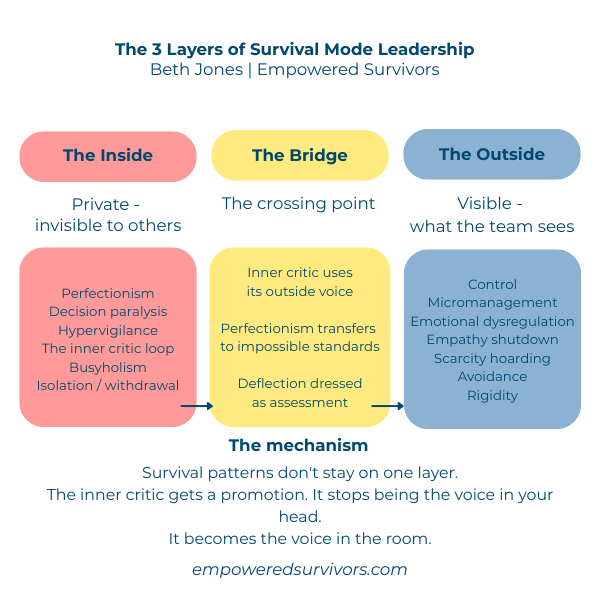
Layer 1: The War Inside the Leader
The first layer is invisible. It is the internal experience of burnout despite success in leaders who are performing at a high level while fighting a private war that never turns off.
- Perfectionism that will not let anything be finished.
- Decisions that circle without landing, undermining decision making under pressure.
- Hypervigilance that reads threat into neutral interactions.
- Emotional triggers at work that produce reactions larger than the moment calls for.
This is why high achievers feel empty even when the results say they should feel accomplished. The performance is real. The survival pattern running underneath it is also real. Both are operating simultaneously, and the gap between what everyone sees and what the leader actually feels is exhausting to maintain.
A Note on Women in Leadership
For women in leadership, this internal war often carries an additional layer: the relentless performance of belonging in rooms where their presence is still treated as provisional.
The impostor syndrome that successful women leaders experience is not a confidence deficit. It is a survival pattern that insists competence is never enough.
The Bridge: Where Private Pain Becomes Public Impact
The second layer is the mechanism that nobody talks about, and it is where the real damage begins.
The inner critic gets a promotion. It stops being the voice in the leader's head and becomes the voice in the room.
The impossible standard a leader has held themselves to for years gets handed to everyone around them.
- Perfectionism crosses the bridge and arrives as endless revisions made at a feverish pace, right up until the project deadline.
- Deflection crosses the bridge dressed as an assessment.
- Blame crosses the bridge, looking like accountability.
The people on the receiving end do not know where it came from. They just know they can never measure up.
I watched this mechanism play out during a corporate investigation when a lead lawyer, facing client dissatisfaction with her own procedural decision, turned to the room and called my exhausted, high-performing team “a Band-Aid.” One word. Our work dismissed, the root cause redirected away from the person responsible, and the insult absorbed without challenge. The leader was not responding to the facts. She was responding to a threat her nervous system perceived, and her survival response landed on the people nearest to her.
Layer 3: What the Team Absorbs Changes Everything
The third layer is what the rest of the organization actually lives with. The team does not experience survival mode leadership as fear. They experience it as the culture.
- They shrink their ideas before presenting them.
- They over-prepare and over-explain.
- They stop raising problems because problems have become evidence of inadequacy.
This is what overfunctioning in leadership looks like from the team's side. Everyone is working harder to manage the leader's nervous system instead of doing the work they were hired to do. The leadership dynamics in the entire organization shift around one person's unexamined survival pattern.
The best people leave. They are professional about it. They do not name the real reason in the exit interview. And the pattern does not break, because the conversation that most needs to happen (the one where someone says “your survival mode is costing both of us”) almost never does.
Why Traditional Approaches Miss the Problem
What Traditional Coaching Targets
Traditional executive coaching and leadership development programs focus on behavior modification:
- communication skills,
- delegation frameworks, and
- emotional intelligence assessments.
These tools address what a leader does without examining why they do it. They teach frameworks for leadership effectiveness without asking why certain leaders cannot access those frameworks under pressure.
What a Trauma-Informed Lens Provides
What is actually needed is a trauma-informed leadership lens. One that starts with what is happening underneath the leadership performance before trying to change the performance itself. Because the leader who called my team “a Band-Aid” did not need a communication workshop. She needed to understand why a perceived threat activated a survival response that overtook her professional judgment. And I know this is true because I've crossed the same bridge myself.
In a debrief meeting, I called someone out publicly, in a tone sharper than anything the moment required, leaving no room for context or dignity. My survival response (caused by exhaustion, external pressure, the sharp edge of sustained high-stakes work) landed on someone who had nothing to do with the cause. That was fifteen years ago. I still think about it because I never got to apologize to her.
What Both Experiences Taught Me
You did not learn bad leadership. You survived something, and survival became your strategy.
It was intelligent and necessary at the time. And it can change. That is exactly what The HEAL Framework™ was built for: interrupting the survival pattern, recognizing the bridge before you cross it, and building a leadership identity rooted in clarity, healing, and genuine connection.
Learn more about The HEAL Framework™
You, Too, Can Heal
If something in this piece found you, I'd like to hear from you.
I work with leaders and organizations at the intersection of healing and leadership performance. If you recognized a pattern in yourself, in someone you lead, or in your organization's culture, email me directly at beth@empoweredsurvivors.com. That goes straight to my inbox, and I will respond to your message.
FAQ's
Survival mode leadership is a pattern of behavior driven by unresolved fear, shame, or threat responses running beneath a leader’s performance. Unlike a bad hire or a wrong market bet, it isn’t a one-off decision error; it is a persistent, unconscious survival strategy that eventually shows up in how a leader relates to their team. It erodes trust, pushes top talent out, and reshapes performance over time because the leader’s nervous system keeps reading threat—even in neutral moments—and that reaction becomes the standard others must work around.
The Three-Layer Framework explains how a leader’s private survival patterns become public culture. Layer 1 is the invisible inner war: perfectionism that won’t let work be finished, decisions that never land, hypervigilance, and outsized emotional reactions (often intensified for women who must continually perform belonging), with imposter syndrome operating as a survival pattern. The bridge is the point where this private pain crosses into the room: the inner critic becomes the team’s critic; perfectionism becomes endless revisions; deflection masquerades as assessment; blame looks like accountability. Layer 3 is what the team actually lives with: a culture of overfunctioning in which people shrink ideas, over-prepare, avoid raising problems, and manage the leader’s nervous system instead of doing their jobs.
Common indicators include: perfectionism that prevents closure or approval, decision loops under pressure, reading threat into neutral interactions, and reactions bigger than the moment warrants. A telltale feeling is emptiness or burnout despite visible success—the gap between external results and internal experience is exhausting. Imposter syndrome shows up not as a confidence gap but as a survival rule that says competence is never enough and belonging must be continually proven.
Once the bridge is crossed, the team absorbs the leader’s survival pattern as culture. People start future-proofing everything, over-explaining, and avoiding surfacing problems because problems become evidence of inadequacy. The organization experiences overfunctioning: energy shifts from creating value to regulating the leader’s state. Trust declines, decision velocity slows, and your best people quietly leave, often without naming the real cause in exit interviews. Then there is also the real cost of rehiring and retraining new staff. Without addressing the underlying cause, the pattern repeats, taxing performance long after any single incident.
Traditional executive coaching targets behaviors—communication tips, delegation models, EQ assessments—without asking why those skills vanish under pressure. A trauma-informed lens starts underneath performance, helping leaders see and interrupt the survival response before it crosses the bridge and hijacks judgment. The HEAL Framework™ was built for this: to interrupt the pattern, help leaders recognize the bridge in real time, and rebuild a leadership identity grounded in clarity, healing, and genuine connection. If you recognize this pattern in yourself or your organization, reach out at beth@empoweredsurvivors.com.
Categories
OUR BLOGS
Recent Posts

What Imposter Syndrome Looks Like Inside a Leadership Meeting
Most of the imposter syndrome conversation stops at the feeling. Not good enough. Don’t belong….
Conflict Avoidance Is a Leadership Behavior With a Measurable Cost
Conflict avoidance goes by a lot of names: patience, diplomacy, being easy to work with….

Stop Performing for Approval and Start Leading
Some of the most capable leaders in an organization are also the most exhausted, and…