
Survival Mode Leadership: How Unresolved Trauma Shapes Leadership Behavior
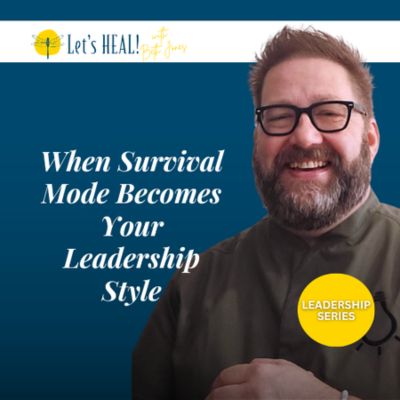
This conversation with Chason Forehand on survival mode leadership starts where most leadership discussions never go: not with strategy or skill gaps, but with what was happening underneath. For years, Forehand led teams in the restaurant and hospitality industry while unresolved trauma from childhood abuse quietly shaped every interaction. Trust issues became harshness. Emotional walls shut down empathy. A need for control kept his team at arm's length. He attributed it to the pressure of the role. He had no idea the two were connected.
What this episode covers
In this episode of Let’s HEAL! — the Leadership Series, Beth Jones sits down with Chason Forehand to name the survival patterns that drive leadership behavior: where they come from, how they cross from the leader’s internal experience into the team’s daily reality, and what it takes to begin changing them. Chason shares three questions that became his personal turning point, and Beth connects them to the broader framework of healing as a leadership performance imperative. If you lead people and you suspect that something underneath your leadership style predates the job, this conversation will give you language for what you’re experiencing and a concrete starting point for change.
Where survival patterns come from and how they show up at work.
Chason’s story is not unusual in its structure. Childhood abuse created survival strategies that worked at the time: hypervigilance, emotional walls, and difficulty trusting others. Those strategies did their job. They kept him safe. But they did not retire when the danger passed. They followed him into the restaurant kitchens he managed, the teams he led, the relationships he tried to build at work.
In his words, trust issues from abuse showed up as being “overly harsh, gruff, and really not a person who has great EQ or empathy as a leader.” He was performing at a high level by every external measure, while the survival pattern ran his leadership style from underneath.
“Addiction morphs until you really get grounded and deal with all the demons from your past.”
— Chason Forehand
This is what survival mode leadership [KW] looks like in practice. The leader is not choosing to be harsh or closed off. The leader is running a strategy built for a threat environment that no longer exists, and applying it to a workplace that requires the opposite: openness, trust, and emotional availability.
Why traditional coaching approaches don’t reach the root cause.
Most leadership development programs would look at Chason’s early behavior and prescribe communication training. An executive coaching engagement might focus on building emotional intelligence skills. And those tools are useful as far as they go. But they address the symptoms without examining the source.
Trauma-informed leadership asks a different question: not “what’s wrong with your leadership style?” but “what happened to the human being who developed it?” When the root cause is a survival pattern that predates the role by decades, skill-based interventions alone cannot produce lasting change. The leader needs to understand why the pattern exists before they can choose a different one.
“We’re not two different people. When people talk about work-life balance, I’m like, no, there’s balance.” — Chason Forehand
Three questions that changed everything.
When Beth asked Chason what he would say to a high-performing leader who looks like they have it all together but feels like something isn’t right on the inside, he didn’t offer a framework from a book. He offered three questions he uses himself:
- What is this that I’m feeling?
- Where does it come from?
- What do I want to do about it?
Beth told him that what he described is a healing journey: self-awareness, identification, and intentional action. He arrived at it through lived experience, not through a certification, a program, or years of experience. That’s the mark of someone who has done the real work of examining their survival patterns and choosing different behaviors.
“We forget about the human element that creates the leader that we are. And that has to be a huge part of our daily journey.” — Chason Forehand
Healing is a career imperative.
For leaders carrying survival patterns into the workplace, doing the work to understand where those patterns come from and choosing different ones is not optional self-improvement. It is a leadership performance imperative. Through The HEAL Framework™ — to Hope, Evolve, And Love, each as an action — leaders can move from surviving to thriving, and their teams benefit directly from that transformation.
“I was failing at that because I was struggling myself.” — Chason Forehand
You, too, can heal.
If something in Chason’s story sounds familiar, you are not alone. And you do not have to stay where you are. The survival strategies that got you through the hard parts of your life served a purpose. They can also change.
Email Beth directly: beth@empoweredsurvivors.com
Read Survival Mode Leadership and It's Hidden Organizational Costs
Q&A: Survival Mode Leadership
Survival mode leadership is when a leader’s unresolved trauma or survival patterns from earlier in life shape how they lead, often showing up as harshness, control, low empathy, or difficulty trusting their team. The leader is not consciously choosing these behaviors; they are running strategies built for a threat environment that no longer exists.
Common signs include difficulty delegating, emotional unavailability, overreaction to minor challenges, chronic distrust of team members, and a gap between external performance and internal experience. Leaders may hit every metric while feeling disconnected, exhausted, or unable to let people in.
Traditional coaching and leadership development programs focus on skills and behaviors without examining the root cause. If the root cause is a survival pattern that formed decades before the leadership role, skill-based interventions alone cannot produce lasting change. Trauma-informed leadership asks where the behavior came from, not just how to manage it.
When leaders address the survival patterns driving their behavior, they gain access to the trust, empathy, and emotional availability that effective leadership requires. Teams respond to leaders who lead from wholeness rather than from a wound. Healing is a career imperative for leaders who want sustained performance and genuine connection with their teams.
The HEAL Framework™ is Beth Jones’s proprietary pathway from surviving to thriving: to Hope, Evolve, And Love, each as an action. It provides leaders with a structured approach to recognizing survival patterns, understanding their origins, and building new behaviors that support leadership performance and personal wholeness.
Categories
OUR BLOGS
Recent Posts

What Imposter Syndrome Looks Like Inside a Leadership Meeting
Most of the imposter syndrome conversation stops at the feeling. Not good enough. Don’t belong….
Conflict Avoidance Is a Leadership Behavior With a Measurable Cost
Conflict avoidance goes by a lot of names: patience, diplomacy, being easy to work with….

Stop Performing for Approval and Start Leading
Some of the most capable leaders in an organization are also the most exhausted, and…