
Child Abuse Prevention: Teaching Body Safety and Consent to Kids
When I think about my five-year-old self, the little girl who experienced sexual abuse, my heart focuses on what could have been different. If someone had taught me about body safety, I might have had the language to describe what was happening.
If the adults around me had understood the signs of grooming, earlier protection may have been possible.
These reflections are at the core of my commitment to child abuse prevention and fuel the work I do today. That is why my conversation with Kimberly King was so powerful. As a child abuse prevention educator, kindergarten teacher, and author of body safety books, Kimberly helps protect children by stopping trauma before it begins.
Why Child Sexual Abuse Prevention Starts Earlier Than You Think

One statistic from our conversation stopped me cold: 68% of children never tell anyone about their abuse. Think about that. The majority of children who experience sexual trauma carry that secret into adulthood, often for decades. The average age when someone finally recalls and processes childhood trauma? Fifty-two years old. I fit that pattern perfectly, talking publicly about my abuse only in my fifties, after spending thirty years in a high-powered forensic investigation career while my unhealed trauma shaped every decision I made.
This is exactly why Kimberly’s work on child abuse prevention is so crucial. She focuses on children ages three to ten because this is when we can make the biggest difference. Here’s what’s revolutionary about her approach: she places the responsibility for child sexual abuse prevention where it belongs, with adults. As she emphasized in our conversation, teaching body safety and consent for kids forms part of the solution.
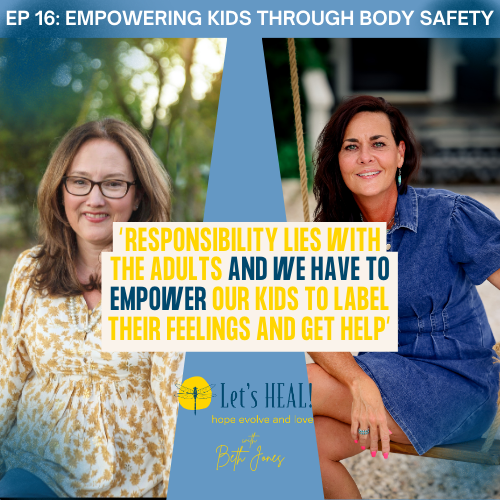
The real responsibility for child sexual abuse prevention lies with adults.
The Reality of Grooming: Beyond Stranger Danger
When most people hear about child sexual abuse prevention, they imagine teaching children to avoid strangers. But Kimberly shared a story that illustrates the true nature of grooming and why understanding it is essential for stopping generational trauma before it begins.
She told me about her friend Shereia, whose child was abused by their nanny. The predator was a woman who methodically groomed the entire family first, becoming indispensable to them. Then she groomed the school and the community, building trust everywhere. Only after establishing herself as beyond suspicion did she target the child. She even threatened to kill the parents and the dog to ensure the child’s silence.
This is what signs of grooming actually look like in real life. Sophisticated, deliberate, designed to exploit our natural desire to trust caregivers. This is why trauma informed teaching and trauma informed parenting are essential skills for child safety at home and beyond.
Body Safety Books and Early Education: Your First Line of Defense
Kimberly’s book, “Body Safety for Young Children: Empowering Caring Adults,” provides a roadmap for breaking the cycle of abuse. What I love most about her approach is how she makes child abuse prevention accessible and manageable for parents who might feel overwhelmed by this difficult topic.
Many parents freeze when thinking about teaching consent for kids or discussing body safety. They worry about saying the wrong thing, traumatizing their child, or lacking the skills to handle the conversation. But Kimberly’s body safety books provide practical, age-appropriate language that empowers both adults and children without creating fear.
Here’s what makes her approach to child sexual abuse prevention so effective: ongoing dialogue that becomes part of your family culture. When you normalize talking about bodies, boundaries, and consent for kids from an early age, you create an environment where children feel comfortable coming to you if something feels wrong.
Creating a Trauma Informed Classroom and Home
As a kindergarten teacher, Kimberly brings a unique perspective to child abuse prevention. She sees firsthand how trauma informed teaching can create safer spaces for children. What does that actually mean in practice?
A trauma informed classroom recognizes that children communicate through behavior, not only through words.
When you’re five years old, like I was when my abuse began, you lack the vocabulary to explain what’s happening to you. But your behavior changes. You might become withdrawn or aggressive. You might have unexplained fears or physical complaints. A teacher trained in trauma informed teaching recognizes these signs and knows how to respond.
The same principles apply to trauma informed parenting and creating child safety at home. Pay attention to behavioral changes, maintain open communication, and create an environment where children know they can tell you anything without fear of punishment or disbelief.
The True Cost of Preventing Child Sexual Abuse
During our conversation, Kimberly and I discussed something that deserves more attention: the massive cost of failing to invest in child abuse prevention. She pointed out that when you consider the lifetime consequences of childhood trauma (the mental health treatment, the career impacts, the relationship struggles, the physical health issues), we’re talking about millions of dollars per person.
But the cost extends beyond finances. Lost potential, broken relationships, decades of suffering. I lived it. My trauma shaped my career choices, my marriage, my entire life trajectory. I was born to be the person I am, but trauma covered that authentic self with layers of survival mechanisms. It took me fifty-plus years and intensive healing work to finally uncover who I was meant to be.
This is what makes child sexual abuse prevention so revolutionary. When we invest in teaching kids about body safety and consent now, we prevent decades of suffering. We allow children to grow up without those masks, to become who they’re meant to be from the start. We literally save lives.
Breaking Family Patterns: Stopping Generational Trauma
One of the most powerful aspects of child abuse prevention is how it interrupts the cycle that passes trauma from generation to generation. When we teach trauma informed parenting and create protective environments, we change the trajectory for future generations.
I’ve spent considerable time doing Family Constellations work to understand and heal the generational trauma in my own family system. What I’ve learned is that unhealed trauma ripples through entire family systems, affecting children, grandchildren, and beyond. This is why breaking the cycle of abuse through prevention is so transformative.
When Kimberly teaches parents about body safety and when she incorporates trauma informed teaching in her kindergarten classroom, she creates ripple effects that will be felt for generations. Every child who grows up understanding body autonomy, who knows how to identify unsafe situations, who feels empowered to speak up becomes an adult who can protect themselves and future children in their lives.
Healing the Inner Child While Protecting Today’s Children
There’s something profound that happens when those of us healing from childhood trauma turn our pain into purpose through child abuse prevention work. I see my five-year-old self in Kimberly’s kindergarten students. That connection between healing the inner child within us and protecting actual children today creates a powerful motivation for this work.
EMDR for childhood trauma and other healing modalities have helped me process what happened to that little girl decades ago. But engaging with child sexual abuse prevention work adds another dimension to healing. It transforms childhood trauma resurfacing in adulthood from something painful into something purposeful.
Kimberly shared that 95% of sexual trauma survivors eventually feel called to help others, a natural outcome of deep healing work. This is turning pain into purpose at its most profound level. Our worst experiences, when transformed through healing, become our greatest contributions to preventing others from suffering the same way.
Practical Steps for Child Sexual Abuse Prevention
Based on my conversation with Kimberly and my own journey, here are actionable steps you can take today to begin child abuse prevention in your sphere of influence:
Educate yourself first.
Before you can teach body safety and consent for kids, understand the realities of child sexual abuse—organizations like Darkness to Light offer excellent training programs. Read Kimberly’s body safety books and other evidence-based resources on child sexual abuse prevention.
Start conversations early.
Age-appropriate discussions about body safety can begin as early as age three. Use correct anatomical terms, teach about body autonomy, and make these conversations normal and ongoing rather than one intimidating talk.
Create a trauma informed home environment.
Practice trauma informed parenting by maintaining open communication, believing your children when they tell you something feels wrong, and never forcing physical affection (even with family members). Teaching kids about consent includes respecting their “no” to hugs and kisses.
Know the signs of grooming.
Predators often are people you trust: family members, coaches, teachers, religious leaders, or babysitters. Watch for adults who seek alone time with children, give special gifts or privileges, or try to become indispensable to your family.
Build your child’s protective network.
Child safety at home extends beyond your four walls. Talk to teachers about trauma informed teaching practices in your child’s school. Connect with other parents who share your commitment to child abuse prevention. Create a community of protective adults around your children.
Practice what Kimberly calls “graduated disclosure.”
Practice listening without judgment to minor complaints and worries. This builds trust, making children more likely to disclose serious problems.
Focus on relationships over rules.
The goal of teaching kids about body safety and consent is to build a relationship where your child knows they can always come to you, that you’ll believe them, and that, together, you’ll figure out how to handle whatever situation arises.
The Intersection of Prevention and Healing
What makes child sexual abuse prevention work so powerful is understanding how it connects to healing. Those of us working through childhood trauma resurfacing in adulthood and processing our experiences through EMDR for childhood trauma or other modalities, we have unique insight into what children need for protection.
We know the isolation that comes from being disbelieved. We understand the confusion of experiencing something we lack words to describe. We’ve felt the shame that makes disclosure so difficult. This lived experience makes us powerful advocates for child abuse prevention and for trauma informed teaching and trauma informed parenting approaches that actually work.
Moving Beyond Fear to Empowerment
One thing Kimberly emphasized that resonated deeply with me: this work is about empowerment. Teaching kids about body safety and consent from an early age protects them. Creating trauma informed classroom environments and practicing trauma informed parenting means creating spaces where all children can thrive, whether or not they’ve experienced trauma.
As Kimberly says on Instagram (where she’s known as Tough Topics Mom), these are tough topics, but they can be handled with care and confidence. When we approach child sexual abuse prevention with knowledge, confidence, and age-appropriate resources like body safety books, we can have these discussions while maintaining hope and joy in our relationships with children.
Why This Matters for Breaking Generational Trauma
Every time we successfully prevent one case of child abuse, we prevent decades of suffering for that child, protect their future relationships, support their mental and physical health, and ensure they can become the person they’re meant to be. We stop generational trauma before it can take root in a new family system.
This is why child abuse prevention deserves the same attention and resources we pour into treating trauma survivors. Both are essential. We need to heal those of us working through childhood trauma resurfacing in adulthood, using EMDR for childhood trauma and other effective modalities. And we need to invest in child sexual abuse prevention so fewer people need that healing in the first place.
Your Role in Child Safety at Home and Beyond

You can make a difference in child abuse prevention.
As Kimberly pointed out, the adults in children’s lives (parents, teachers, coaches, relatives, neighbors) are the first and most important line of defense.
Learning the signs of grooming, understanding trauma informed parenting principles, teaching body safety and consent for kids in age-appropriate ways, and creating child safety at home through open communication are skills any caring adult can develop.
Start with one step. Read Kimberly’s book “Body Safety for Young Children” or another trusted resource on child sexual abuse prevention. Take a training through Darkness to Light. Have one conversation with a child in your life about body autonomy. Join or create a community of parents and caregivers committed to breaking the cycle of abuse through prevention.
The Ripple Effect of Prevention
What gives me profound hope about child abuse prevention work is understanding how one protected child creates ripples that extend through entire communities. When we successfully implement trauma informed teaching in one classroom, those children grow up with better boundaries and awareness. They become parents who practice trauma informed parenting. They create child safety at home for their own children. They recognize and intervene when they see signs of grooming in their communities.
This is how we actually break generational trauma by ensuring the next generation experiences less trauma in the first place. Every child who grows up learning about body safety and consent for kids, every family that implements trauma informed parenting principles, every school that creates a truly trauma informed classroom, each of these becomes a protected space that radiates outward.
Turning Pain Into Purpose Through Prevention
My conversation with Kimberly reminded me why my own healing journey led me to become “the healing mentor.” Our pain, when transformed through healing work like EMDR for childhood trauma and other modalities, becomes our greatest source of power and purpose. But that purpose extends beyond our own healing.
When those of us healing from childhood trauma resurfacing in adulthood turn our attention to child abuse prevention, we complete a sacred cycle. We take the worst things that happened to us and use that experience to ensure fewer children suffer the same way. We become the protective adults we needed when we were young.
This is turning pain into purpose at its deepest level. Breaking the cycle of abuse for good. Stopping generational trauma in its tracks.
Creating a world where body safety books are as common as bedtime stories, where trauma informed teaching is standard practice in every classroom, where trauma informed parenting is simply called “good parenting,” and where every child grows up understanding consent for kids as a fundamental right.
Save a Life Now!
If you’re reading this as someone healing from your own childhood trauma, please know that your healing matters and so does your voice in prevention work. Your lived experience, your understanding of what children need, your commitment to breaking the cycle of abuse are powerful forces for change.
If you’re reading this as a parent, teacher, or caring adult in children’s lives, please know that child sexual abuse prevention is everyone’s responsibility. Learning about the signs of grooming, teaching body safety and consent for kids, creating child safety at home, and practicing trauma informed parenting are essential skills for protecting children in today’s world.
And if you’re reading this feeling overwhelmed, please start small. One conversation. One book. One training. One step toward understanding child abuse prevention. That single step could change a child’s entire life trajectory. It could prevent decades of suffering. It could literally save a life, perhaps more than one life, when you consider the ripple effects through families and generations.
As Kimberly said in our conversation, we need to move the needle to where talking about body safety and consent for kids becomes part of how we raise children. Where trauma informed teaching becomes standard practice. Where trauma informed parenting is simply what parenting looks like. Where child safety at home is a given, an expectation.
We can create this world. One conversation at a time. One child at a time. One family system healed and protected at a time. The work of breaking the cycle of abuse and stopping generational trauma through child abuse prevention is work we can all do. Work we must all do.
Because every child deserves to grow up without the trauma I experienced. Every child deserves to become who they’re meant to be from the start, without spending decades uncovering their authentic self from beneath layers of survival mechanisms. Every child deserves to learn about body safety and consent for kids in a way that empowers rather than frightens them.
This is how we heal entire generations, not only ourselves. This is how we turn our pain into purpose. This is how we save lives by preventing trauma before it begins. Ready to take action on child abuse prevention?
Visit Kimberly King at kimberlykingbooks.com to order body safety books for the children in your life.
Follow her on Instagram and Facebook at Tough Topics Mom for ongoing child sexual abuse prevention education.
Take Darkness to Light training to learn the signs of grooming and effective prevention strategies. And for more resources on healing the inner child while protecting today’s children, visit my community at EmpoweredSurvivors.com.
Kimberly King
Full Episode:
Categories
OUR BLOGS
Recent Posts

What Imposter Syndrome Looks Like Inside a Leadership Meeting
Most of the imposter syndrome conversation stops at the feeling. Not good enough. Don’t belong….

Conflict Avoidance Is a Leadership Behavior With a Measurable Cost
Conflict avoidance goes by a lot of names: patience, diplomacy, being easy to work with….

Stop Performing for Approval and Start Leading
Some of the most capable leaders in an organization are also the most exhausted, and…