
When You’re the Calm One in the Room: How Composure Becomes a Survival Pattern in Leadership
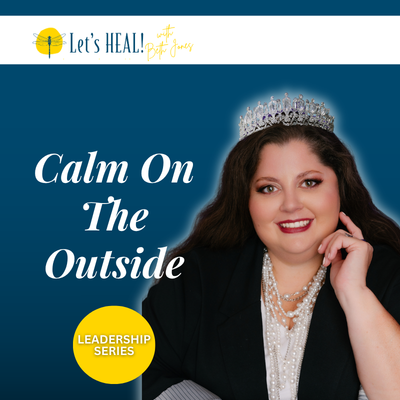
There is a version of survival mode leadership that looks nothing like struggling. It looks like calm. It looks like competence. It looks like the person everyone calls when things fall apart — and who answers every time, dispatches the right people, notifies the right chain, and holds the room together.
From the outside: completely calm. From the inside, in the words of Jessica Hammock: “my little heart is fluttering away like little legs underneath the pond.”
That is the duck on the pond. And for a long time, Jessica had no name for it.
What This Episode Covers
Jessica Hammock is the Director of Behavioral and Mental Health for one of the largest charter school networks in Texas — 100 campuses, 25,000 students, 12 counselors underneath her, and a phone that rings when someone dies. In this episode of the Leadership Series of Let’s HEAL! with Beth Jones, Jessica and Beth unpack what survival mode leadership looks like when you’re the designated calm one: the overfunctioning, the go mode, the physical cost of owning everyone else’s outcomes.
The episode covers how a performance-based identity shows up long before a leadership title does, why “leave your problems at the door” is not just bad advice but physiologically impossible, and what it actually looks like to lead from giftedness rather than false responsibility. If you have ever been the person everyone else depends on and wondered what it costs, this conversation is for you.
The Go Mode and What It Actually Costs
Jessica describes the moment a crisis call comes in as a switch into “go mode” — a first-responder state in which she assesses the situation, dispatches appropriate personnel, notifies her C-suite, contacts families, and coordinates communications, all while remaining completely composed. The calm is real. And the calm is also a performance.
What most people on the receiving end of that composure never see is what’s happening on the inside. Her description is precise: “outside people have said, you’re so calm, like you just navigate that so well. But internally, my little heart is fluttering away like little legs underneath the pond.”
“Outside people said you’re so calm. But internally, my little heart is fluttering away like little legs underneath the pond.”
— Jessica Hammock
This is what survival mode leadership looks like when the pattern is competence. The leader is not failing. The leader is performing at a genuinely high level. The problem is that the performing and the leading have become the same thing — and the cost of maintaining that equation is invisible until it isn’t.
For Jessica, the cost made itself undeniable early on. Before she had a team — when she was the sole mental health resource for 60 campuses spread across the state of Texas — she got physically sick. “Body congestions, sicknesses, illnesses, had to take more time off work, became like really sludgy in every part of my life physically.” The body was keeping the score before she knew to look.
The Overfunctioning Leader
Even after she built a team of 12 counselors underneath her, the pattern surfaced again in a different form. A crisis on a campus she felt particularly connected to, and her immediate instinct: I have to go, I have to be there. Her boss’s response: you literally landed from a week-long trip to El Paso at 10pm last night. You are not getting in the car.
That moment is worth sitting with. Not because the boss was wrong — she was right — but because of what drove the impulse. “There’s still a version of me that is from ten years ago,” Jessica says. “I have to go, I have to do the thing.” The leadership pattern and the survival pattern are the same pattern. Showing up is how she proved her worth. Staying was not optional. And the team underneath her — the very team she had built to carry this load — had to be trusted enough for her to stay away.
The Lie We Tell Ourselves About Leaving It at the Door
At some point in almost every organization, the message gets communicated — explicitly or otherwise: leave your personal problems at the door. You are a professional. This is work.
Jessica is unambiguous about this: “Leave your problems at the door is a lie. It’s actually impossible. So let’s not pretend that we’re going to do that.”
“Leave your problems at the door is a lie. It’s actually impossible. So let’s not pretend that we’re going to do that.”
— Jessica Hammock
The more productive question for leaders is not how to enforce that separation but how to recalibrate when someone on the team — or the leader themselves — cannot maintain it. What is the best version of what I can bring today? What does showing up actually look like from where I am right now?
Jessica describes what happens when leaders give themselves that grace: “We actually allow our nervous system to relax just a bit and we take the pressure off ourselves and then we can actually become essentially more productive.” Suppressing the reality does not raise performance. Acknowledging it and recalibrating does.
What the Team Sees When a Leader Carries It Alone
The survival pattern that runs inside a leader does not stay inside a leader. It lands on the team. Jessica names this directly: when a team member is carrying trauma — or when the leader is — the whole workflow hits a disruption. The connections, the relationship capacity, the movement toward the goal, all of it is affected. And a leader who is too consumed by their own stress to see that disruption will miss the recalibration that the whole team needs.
This is what trauma-informed leadership actually means in practice. Not a therapeutic framework applied to the workplace. A leader who is awake to what is running in the room — and in themselves.
The False Sense of Responsibility
The sharpest shift in this conversation comes when Jessica describes what happened to her relationship with crisis. Early on, she carried it all: “You’re the expert, what do we do?” And she treated that as a question with only one answer. I fix this. I make it okay. I produce the outcome.
The result was physical illness, 2am spirals, and a loop of internal questioning that never resolved: Did I say the right thing? Did I give enough support? What if the outcome isn’t what it should be?
The shift came from recognising that owning every outcome was never actually her responsibility. “Owning the weight of everybody else’s choices and outcomes was not mine to own.”
“Owning the weight of everybody else’s choices and outcomes was not mine to own.”
— Jessica Hammock
She reframes the horse-to-water maxim in a way that reframes leadership accountability entirely: a leader can provide 20,000 different opportunities, the right conditions, the right support. The horse still chooses whether to drink. And if the horse doesn’t drink, that is not a leadership failure. The horse has its own free will.
What changes when a leader internalises this is not that they stop caring. They stop absorbing. The work still matters. The outcome no longer defines them.
What Survival Mode Looks Like in Your Strengths
Jessica identifies the original root of the pattern: a performance-based identity formed long before any leadership role. “I felt like I had to perform a certain way for love and acceptance and chosenness.” When that belief moves into a leadership context, it looks like competence. It looks like the person who can do everything. And it looks like extreme discomfort delegating — because if someone else does the thing, what does that leave?
Her list of the survival-pattern-driven behaviors she has had to unlearn:
- Forcing herself to spend time in areas of frustration because not mastering them felt like failure
- The two-word loop: figure it out. Regardless of the cost.
- Getting in the car when her body — and her boss — were both telling her not to
- Crying in meetings from a place of unprocessed intensity rather than named need
What she has learned instead: her giftedness is reading the emotional temperature of a room without anyone saying a word. Her giftedness is communication. She is the person friends call before they send an email that might get them fired. Spreadsheets are not her giftedness. She has someone for that.
The unhealed version had to figure out the spreadsheet so colleagues would think she was competent. The healed version calls the person who can do it in 30 minutes and offers something in return.
Resource: Leadership Self-Assessment
Listen to the Full Episode
This conversation is available now on the Leadership Series of Let’s HEAL! with Beth Jones on YouTube, Apple Podcasts, and Spotify. Find the episode at @bethjoneshealingmentor on YouTube.
To connect with Jessica Hammock directly, visit vibrantvoice.life.
If this conversation is sitting with you in a way you want to explore, email Beth directly: beth@empoweredsurvivors.com.
Q&A
Survival mode leadership happens when the coping patterns a person developed to navigate difficulty — before or outside of work — run their leadership behavior without their awareness. It shows up as the constant fixer, the person who can’t delegate, the leader who cannot leave it at the door because they were never wired to. Survival mode leadership is not weakness. It is a pattern that made sense once and now runs at cost.
Burnout in high-performing leaders often comes not from the work itself but from owning what was never theirs to own: every team member’s outcome, every crisis’s resolution, every horse at the water. When a leader’s sense of worth is tied to the performance of everyone around them, the load is unlimited. Recognising that boundary — I get to show up fully, and the outcome belongs to the person making the choice — is what shifts the equation.
In practice, trauma-informed leadership means a leader who is awake to what is running in themselves and in the room. Not a therapeutic framework applied to the workplace. A leader who can name when a disruption on the team is a trauma response rather than a performance issue, and who has done enough of their own healing work to recalibrate rather than absorb.
The leaders in this conversation name two things consistently: first, having your own oxygen mask on — your own therapist, mentor, or industry peer who can let you process before you walk into the room. And second, trusting the team you built. Overfunctioning is not leadership. Dispatching the right person, staying out of the car when you shouldn’t be in it, and checking in on Monday — that is leadership.
The HEAL Framework™, developed by Beth Jones, is a proprietary pathway from surviving to thriving: Hope, Evolve, And Love — each as an action, not a concept. In a leadership context, The HEAL Framework™ provides the structured pathway for leaders who recognise survival patterns in their own behavior and want to change them.
Beth Jones | Leadership Performance Strategist | The HEALing Mentor | Founder, Empowered Survivors
Categories
OUR BLOGS
Recent Posts

What Imposter Syndrome Looks Like Inside a Leadership Meeting
Most of the imposter syndrome conversation stops at the feeling. Not good enough. Don’t belong….
Conflict Avoidance Is a Leadership Behavior With a Measurable Cost
Conflict avoidance goes by a lot of names: patience, diplomacy, being easy to work with….

Stop Performing for Approval and Start Leading
Some of the most capable leaders in an organization are also the most exhausted, and…