
Why Capable People Hide Behind People Pleasing at Work, and What It Costs the Team

If you have ever written that sentence in someone’s review, or heard it in your own, this post is for you. My guest on the Leadership Series of Let’s HEAL!, Lydia Davis, heard it from her bosses for years. They were right about the capable part. What they couldn’t see was why her confidence never showed up at work, and that had nothing to do with skill.
Lydia is a survivor of childhood sexual abuse. For decades, people-pleasing kept her quiet, careful, and endlessly accommodating in a high-pressure career. Her work always got done. Her voice rarely got heard. I see this pattern in leaders and teams all the time, and I lived my own version of it.
Summary
People-pleasing at work is often a survival pattern: a protective strategy someone learned early, when keeping other people happy was how they stayed safe.
The pattern moves through three layers. It starts in the Fortress (private and invisible), surfaces at the Bridge (early signs others notice), and ends in the Radius (what the team and organization experience). Lydia’s story shows all three.
Feedback like “you just need confidence” treats the symptom and misses the root cause. In high-pressure roles, the same pattern also makes it nearly impossible to say “I need help,” the very sentence that starts the healing.
Leaders who learn to recognize the pattern can make that sentence safer to say. And people who recognize it in themselves can change it. You, too, can heal.
People-pleasing at work is a survival pattern.
A survival pattern is a strategy your nervous system adopted to keep you safe. For a child living with abuse, keeping everyone around you calm, never putting a foot wrong, and staying small is a very good strategy. The trouble is that the strategy doesn’t retire when the danger does. It follows you into adulthood, into your marriage, and into every meeting room you walk into.
In the workplace, people-pleasing tends to look like this:
- Agreeing in the meeting and disagreeing in your head (or never disagreeing at all)
- Assuming you are the one in the wrong when a relationship feels off
- Over-analyzing colleagues’ reactions long after a conversation ends
- Delivering everything on time and never speaking up about what you think
- Pushing through distress so no one else is let down
Lydia described almost every item on that list. She called herself a people pleaser who was “on the teetering edge of upsetting others,” paranoid about friendships and colleagues, and certain she must have done something wrong.
The pattern moves through three layers.
I use the Leadership Impact Model to show how a private survival pattern becomes something a whole team experiences.
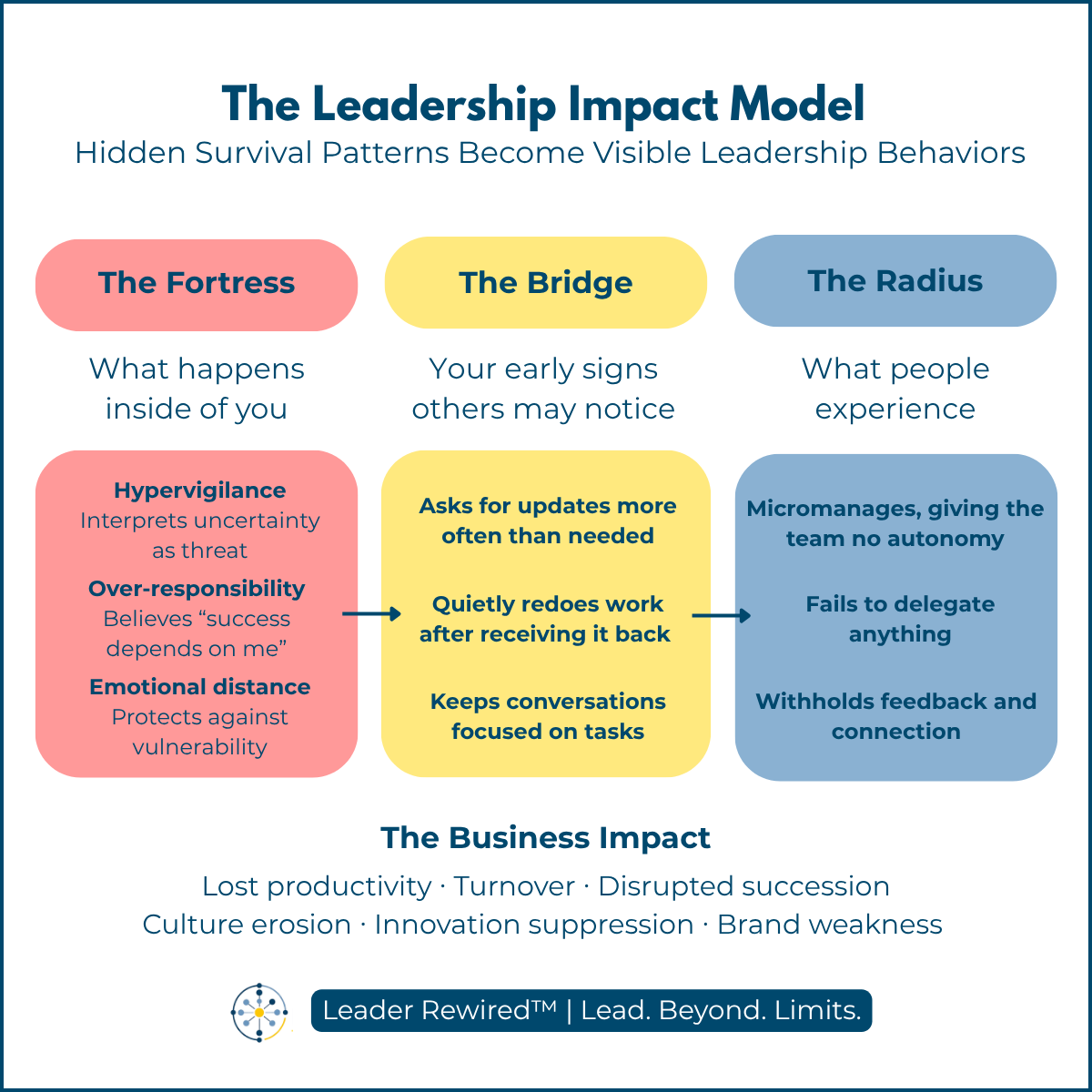
The Fortress is private and invisible.
This is where the pattern lives before anyone sees it. For Lydia, the Fortress held a twenty-year weight battle she didn’t yet understand. In her words: “I didn’t realize that my weight was my protection.” It also held the constant expectation of being in the wrong.
The Bridge is where early signs show.
At the Bridge, the private pattern leaks into observable behavior. Lydia was quiet in a way that read as low confidence. Later, after her abuser died and her grief surfaced, she started taking herself off to a secluded office with a ready excuse and closing the door so no one could see what was really going on: tears falling. A closed door is a signal. Most leaders walk right past it.
The Radius is what others experience.
Her team and bosses experienced reliable output, but they missed her voice. They got Lydia’s work. They rarely got Lydia.
You can go, and you can do your job, and you can do your job well, but can you do it to the fullest extent of what you would do if you were being completely yourself? I don’t think you can.
I agree with her. No matter how successful someone is, an unhealed survival pattern sets a ceiling on leadership performance, no matter the level.
“You just need confidence” misses the root cause.
Confidence feedback assumes the person lacks a skill or mindset. When people-pleasing is a survival pattern, the person’s nervous system is doing exactly what it learned to do. Telling them to be more confident is like telling someone to stop flinching: the flinch has a reason.
A more useful question for a manager is what this person is protecting themselves from. You can ask it without knowing their story, and it moves the conversation toward the underlying root cause.
High-pressure roles make “I need help” the hardest sentence to say.
Lydia spent years in a high-pressure career that could be very stressful. When burnout or a trigger hit, she couldn’t always tell whether the job, the trauma, or both were driving it. And she noticed that colleagues without her history burned out too. High pressure brings whatever someone is carrying to the surface.
The culture of those roles also makes admitting it feel dangerous. Lydia described it as having to stick your head above the parapet. For someone with a people-pleasing pattern, the shame doubles: we tell ourselves we should be healed by now, or at least getting on with our lives.
If you say those words, you can then work through them, and you can then be a better person, and you can then be a better colleague and a better leader.
In the end, Lydia’s colleagues said the words for her. They told her she shouldn’t be at work, and one of them drove her home. She took about six months off to heal. I took three or four weeks to tell my own organization what I was dealing with, and I remember every one of them.
What leaders and organizations can do.
Trauma-informed leadership starts with noticing patterns and making it easier to ask for help. A few places to start:
- Treat a change in someone’s pattern (a closed door, new silence, crying, withdrawal) as information worth a private, kind conversation
- Replace “you just need confidence” with curiosity about what makes speaking up feel risky
- Make it normal for senior people to say “I’m struggling” out loud
- Build leave and return-to-work practices that let people heal without losing their place
If you bring speakers or workshops into your organization, this is the conversation I have with leadership teams in my newest keynote, Leader Rewired: Lead Beyond The Limits of Your Survival Patterns.
Every person in the room carries an invisible sign.
Lydia’s keynote is called The Invisible Sign. Her point is simple and true: every person in every room, from the boardroom to the supermarket, carries a sign none of us can read.
Every person carries their own invisible sign, and none of us knows what words are written on it.
Understanding our own sign is how we start reading other people with compassion. That is the heart of The HEAL Framework™: Hope, Evolve, And Love, each as an action. Lydia found her way through movement, education, and the courage to stop pushing through. Her healing began two and a half years ago, and today she helps others through Right Track Wellbeing and her podcast, Riding the Trauma Train.
If you recognized yourself or someone on your team in this post, I would love to hear from you. Email me directly at beth@empoweredsurvivors.com.
You, too, can heal. And when you do, you lead, live, and love better.
Key Quotes
“It would have been a total front. I would have been wearing the thickest mask ever.” (Lydia Davis)
“I didn’t realise that my weight was my protection.” (Lydia Davis)
“If you say those words, you can then work through them and you can then be a better person and you can then be a better colleague and a better leader.” (Lydia Davis)
“Happiness is built on feeling rather than looking.” (Lydia Davis)
Q&A
It can be, but people pleasing at work is often a survival pattern, a protective strategy learned early when keeping others happy meant staying safe. The person may be highly capable, with a nervous system that prioritizes safety over speaking up.
Childhood trauma can leave survival patterns such as people pleasing, hypervigilance, or over-responsibility that show up in how someone leads and works. These patterns protect the person but cost the team, often by limiting voice, trust, or delegation. Healing the pattern changes the observable behavior.
In high-pressure, high-stakes roles, admitting you are struggling can feel like a career risk. For people with a people-pleasing survival pattern, shame adds weight: they feel they should already be healed or coping. Saying “I need help” is often the step that makes recovery possible.
Trauma-informed leadership means noticing changes in someone’s behavior without needing to know their story, and making it safe for them to ask for help. It replaces judgments like “they just need confidence” with curiosity about what the person might be protecting themselves from.
A manager rarely knows, and doesn’t need to. Watch for changes in behavior: withdrawal, a closed door, new silence, or visible distress. Respond privately and kindly, and make support easy to reach.
Beth Jones | Leadership Performance Transformation Expert | Creator, Leader Rewired™
Categories
OUR BLOGS
Recent Posts
Leadership Burnout Starts in the Body: What Stress Costs Leaders and Their Teams
Most leaders I talk with can tell you, almost to the hour, when their energy…

Six Signs Image Management Is Shaping Leadership Behavior on Your Team
Most organizations have at least one person nobody ever questions. Their work arrives on time…

Why Capable People Hide Behind People Pleasing at Work, and What It Costs the Team
If you have ever written that sentence in someone’s review, or heard it in your…