
How Overfunctioning in Leadership Hides in High-Performing Teams
I spent thirty years reading behavior for a living, first as a financial statement auditor, then as a forensic accountant investigating white-collar crime. That training taught me to spot the exact point where a person's effort stops producing results and starts producing errors. I could see it in my team from across a room. I could not see it in myself for twenty-five years.
The survival pattern that allows that gap to occur has a name. It's called overfunctioning in leadership, and it's more common, and more invisible, than most performance reviews will ever catch.
In this article
Overfunctioning in leadership looks like dedication from the outside and depletion from the inside. It's often driven by a survival pattern I call Validation Through Achievement, in which a leader's sense of worth becomes tied to constant output. The behavioral expression is often busyholism: a compulsive, constant motion that reads as ambition but functions as avoidance.
The cost is a specific and dangerous blind spot. A leader who is highly skilled at spotting diminishing returns in their team can remain completely unable to apply that same diagnostic skill to themselves.
Organizations can address this at the structural level, and leaders can address it personally, using an Empowered Survivors’ framework called the Leadership Impact Model to locate where the pattern lives: privately, in the transition to visible behavior, or in what the team actually experiences.
This piece walks through what overfunctioning in leadership looks like in practice, where it comes from, and what changes when a leader finally turns their own diagnostic instinct inward.
What overfunctioning in leadership actually looks like.
Overfunctioning rarely announces itself for what it actually is because it looks like competence. Here are the behaviors that tend to distinguish it from ordinary hard work:
- Inability to delegate, even when delegation would produce a better outcome
- Multi-tasking treated as identity rather than a tool used when genuinely useful
- Discomfort with unstructured time that reads as restlessness or guilt
- A pattern of adding more to one's own plate rather than asking for help
- Team members who report feeling protected, while the leader reports feeling constantly behind
None of these are character flaws, and they can indicate other survival patterns at work. In this case, they are the visible expressions of a nervous system that learned, somewhere long before the workplace, that output was the price of belonging.
Where overfunctioning in leadership comes from.
The environment often manufactures it.
Some of the pressure that produces overfunctioning isn't personal at all. It's structural in the workplace. Professions built around fixed external deadlines, whether that's a CPA's busy season or an investigator's court date, create an environment where the default organizational response is to pile more work onto already-stretched people rather than add resources. Leaders who come up inside that environment often absorb its logic without ever examining it: the assumption that meeting the deadline matters more than how many people it costs to meet it.
There's a healthier response available, and it isn't simply “work fewer hours.” It's asking people for more, honestly and directly, in a conversation that respects what's actually being asked of them, and then watching closely for the specific point where that request stops producing results and starts producing errors. When that point arrives, the answer is more people or more process, not more pressure on the same people. Some organizations even hire for a specific deadline-driven project rather than against a future growth curve, treating the added headcount as a bridge rather than a permanent bet.
The point here is to add resources as a relief valve, but that only works if the hiring process itself is transparent. The organization must either make it clear that the added headcount is project-related and therefore temporary, or develop a strategy to make it permanent.
The blind spot compounds it.
Here is the part that makes overfunctioning and Validation Through Achievement so persistent. A leader with strong observational skills, the kind built through years of reading behavior professionally, often becomes highly attuned to diminishing returns in their team: the tired errors, the missed details, the point where more effort stops producing more results. That same leader can remain completely unable to see the identical pattern in their own life. The training generalizes outward. It rarely generalizes inward without deliberate work.
This isn't a failure of intelligence or willpower. The diagnostic skill was built to protect other people, often because the leader once needed, and didn't get, that same protection earlier in their own career (or life). Turning the same lens on oneself requires recognizing that the skill was always available. It was just never pointed in that direction.
A day with nothing to show for it didn't feel restful. It felt like a day that didn't count.
The Leadership Impact Model: where this pattern actually lives.
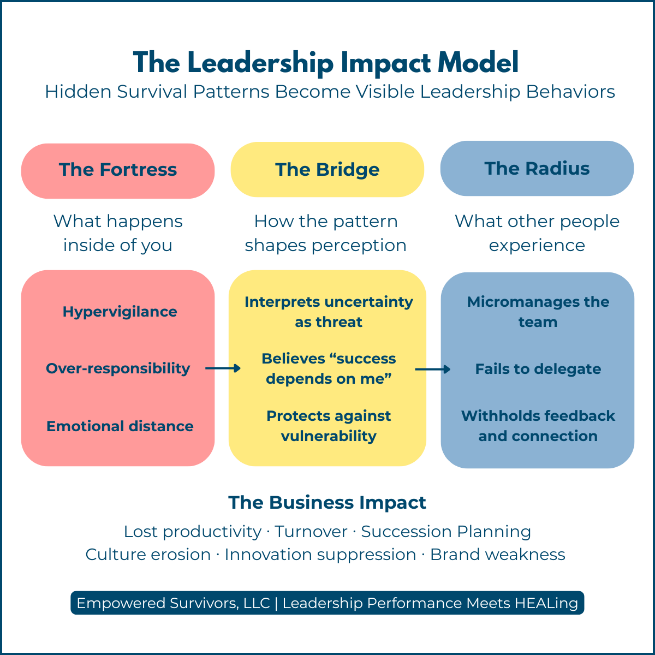
The Leadership Impact Model maps a survival pattern across three layers, making it useful for diagnosing overfunctioning, because the pattern operates differently at each layer, and organizations often have visibility into only one of the three.
- The Inside (private, invisible): worth measured by output, formed long before any job existed
- The Bridge (where inside becomes outside): the behavioral expression, often busyholism or overfunctioning, constant motion that looks like ambition
- The Outside (visible, team sees): a leader who may protect the team's limits while never once applying that same protection to their own
This is why overfunctioning is so easy to miss in a performance review. The Outside layer, the only one visible to an organization, can look like excellence: a leader who delivers, who protects the team, who never misses a deadline. The cost is entirely absorbed at the Inside and Bridge layers, invisible until it isn't.
What changes when a leader sees their own pattern.
The shift isn't about working less. It's about learning that stillness isn't a threat. In my own case, the constant motion of thirty years had been protecting me from a specific fear: that without visible output, I had no proof I mattered. That fear formed decades before any job title, and no amount of professional success ever fully answered it, because the achievement was never actually the question being asked.
Naming the fear precisely was what let the pattern loosen its grip, through a structured process to hope, evolve, and, ultimately, love: believing worth could be true on a day with nothing to show for it, choosing rest as a decision rather than an emergency when your body shuts down, and finally extending the same care inward that had always gone outward first.
Something that once kept you safe is still running your life long after the danger passed. You can change what it costs you.
Does this describe someone in your organization or your own leadership?
If you're evaluating whether this pattern is showing up on your team or in yourself, I'm glad to talk it through directly. Email me at beth@empoweredsurvivors.com.
Questions people ask about overfunctioning in leadership.
It's a pattern where a leader takes on more than is sustainable, often by failing to delegate or ask for help, and is driven by a deeper survival pattern (Validation Through Achievement) in which self-worth becomes tied to constant output.
No. Hard work is a choice made from capacity and/or it has a defined end when the related project is complete. Overfunctioning is a compulsion driven by an underlying fear that without visible output, one's worth is in question. So even when a project ends, or is nearing completion, the person will take on something else to pour into.
Common signs include an inability to delegate even when delegation would help, discomfort with unstructured time, and a habit of adding to their workload rather than requesting more resources.
Diagnostic skill, including the ability to spot diminishing returns, often develops as an outward-facing skill. It does not automatically apply inward, especially when the leader's identity is built around being the person who doesn't need help.
It's a framework that maps a survival pattern across three layers: The Inside (private, invisible), The Bridge (where the private pattern becomes visible behavior), and The Outside (what the team actually experiences).
Looking for the evidence and naming the pattern accurately, ideally with a structured tool like the Leadership Impact Self-Assessment [Internal Link to the Self-Assessment], is usually the first step, since the pattern relies on staying unnamed to keep running.
Categories
OUR BLOGS
Recent Posts

What Imposter Syndrome Looks Like Inside a Leadership Meeting
Most of the imposter syndrome conversation stops at the feeling. Not good enough. Don’t belong….
Conflict Avoidance Is a Leadership Behavior With a Measurable Cost
Conflict avoidance goes by a lot of names: patience, diplomacy, being easy to work with….

Stop Performing for Approval and Start Leading
Some of the most capable leaders in an organization are also the most exhausted, and…